Build vs Buy A Decision Framework for Business Software
No software vendor can answer this honestly because they only sell one side of it. A scoring framework for deciding whether to build custom or buy off the shelf.
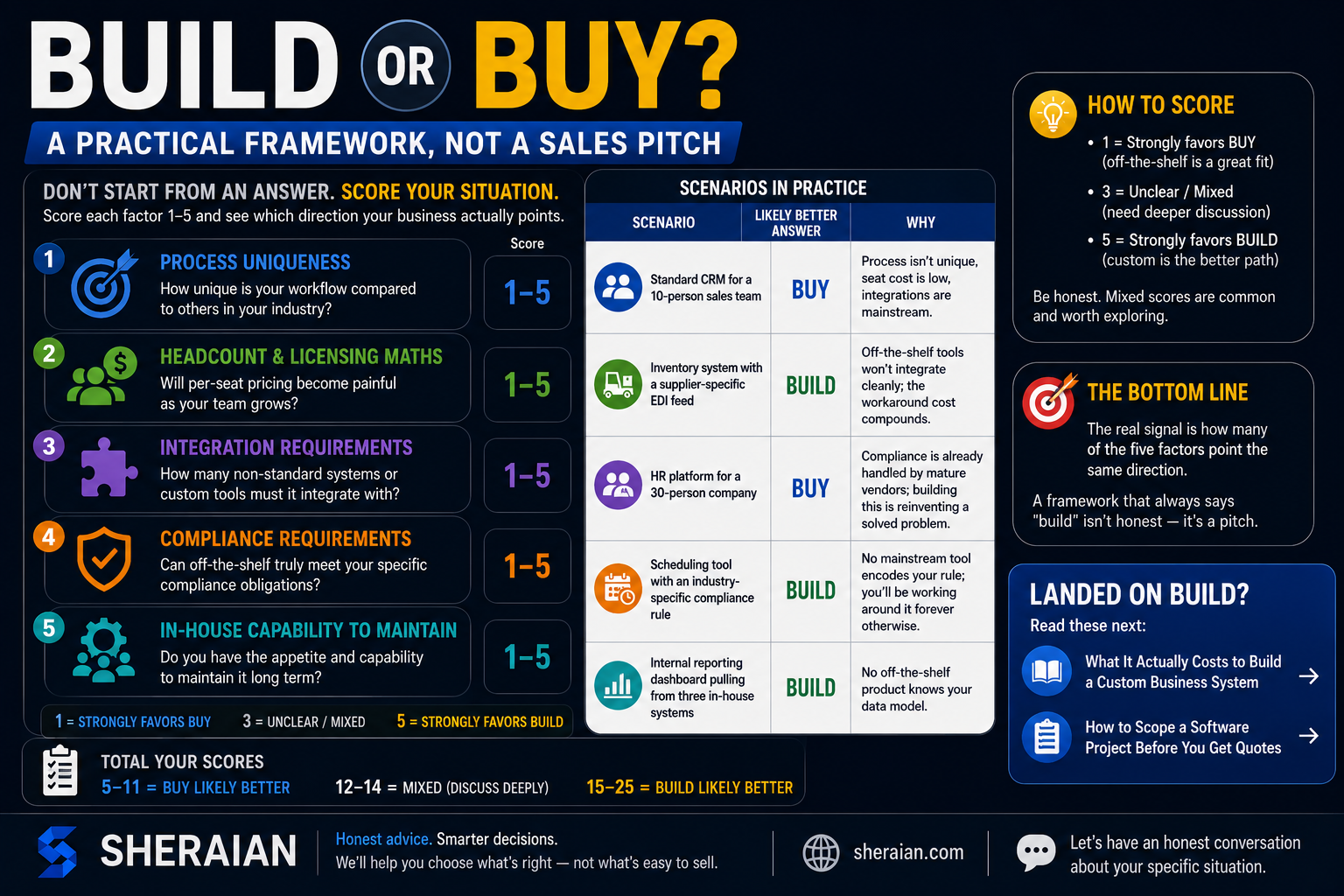
Build vs Buy A Decision Framework for Business Software
Every software vendor's answer to "should I build or buy?" is the same buy — specifically, buy theirs. And every agency's answer tends to be build. Neither is a decision framework, they're sales pitches. Here's a scoring approach that doesn't start from an answer.
Score these five factors:
1. Process uniqueness
If your workflow is close to how everyone else in your industry works, an off-the-shelf tool has already been shaped by hundreds of similar businesses' feedback — you'll get more for less. If your process is genuinely unusual (a scheduling rule, a compliance step, a pricing model competitors don't have), off-the-shelf software will fight you every step, usually through endless workarounds and spreadsheets bolted on the side.
2. Headcount and licensing maths
Per-seat SaaS pricing is cheap at 5 users and painful at 200. Run the maths over 3–5 years, not month one a £15/user/month tool is £900/month at 60 users, or £54,000 over five years often more than a custom build with no ongoing per-seat cost, just hosting and maintenance.
3. Integration requirements
Off-the-shelf tools integrate well with other popular off-the-shelf tools. They integrate poorly with your specific legacy system, your supplier's EDI feed, or another custom tool you already built. The more your software needs to talk to things that aren't mainstream SaaS, the more the buy option starts costing you in workarounds and middleware.
4. Compliance requirements
If you're in a regulated space, check whether the off-the-shelf option can actually meet your specific compliance obligations (data residency, audit trail depth, retention rules) — not just whether it's "GDPR compliant" in general marketing terms. Sometimes it can't, and that alone settles the decision.
5. In-house capability to maintain
Buying software means the vendor maintains it. Building means someone — you or an agency on retainer — needs to keep maintaining it indefinitely. If you have no appetite for ongoing technical relationship management, that's a real cost of building, not a footnote.
Scenarios and the better answer
ScenarioLikely better answerWhyStandard CRM for a 10-person sales teamBuyProcess isn't unique, seat cost is low, integrations are mainstreamInventory system with a supplier-specific EDI feedBuildOff-the-shelf tools won't integrate cleanly; the workaround cost compoundsHR platform for a 30-person companyBuyCompliance is already handled by mature vendors; building this is reinventing a solved problemScheduling tool with an industry-specific compliance ruleBuildNo mainstream tool encodes your rule; you'll be working around it forever otherwiseInternal reporting dashboard pulling from three in-house systemsBuildNo off-the-shelf product knows your data model
Notice several of these land on "buy" — that's deliberate. A framework that always says "build" isn't honest, it's a pitch. The real signal is how many of the five factors point the same direction. If it's a mixed picture, that's worth a proper conversation before either option gets committed to.
If you land on "build," our cost breakdown and scoping guide are the natural next reads.