Custom Admin Dashboards: What to Build and Why
Custom admin dashboards fit roles, content and reporting to how your team actually works; generic panels assume a workflow that is not yours.
Custom Admin Dashboards: What to Build and Why
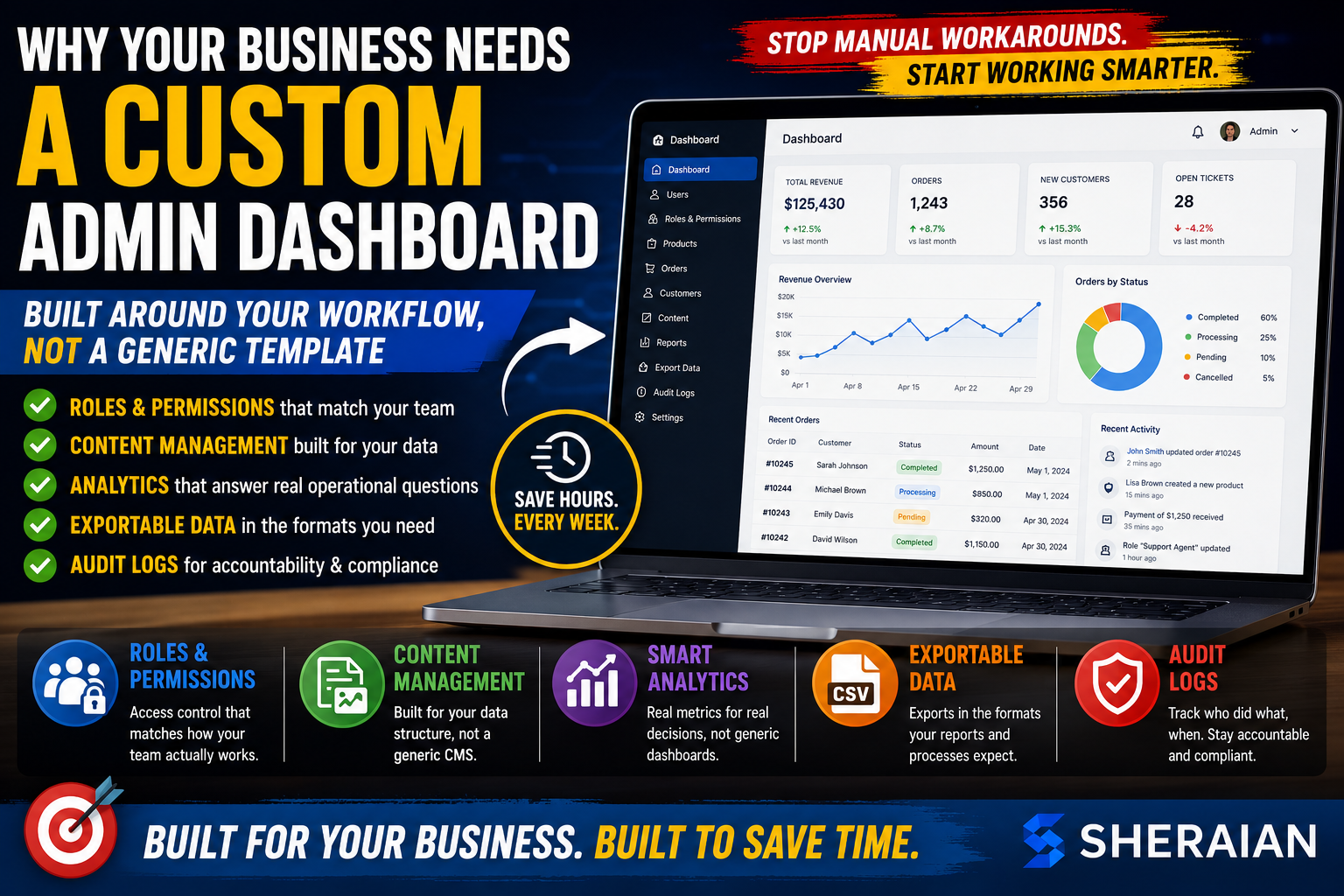
A custom admin dashboard needs roles and permissions matched to how your team actually works, content management for whatever your business runs on, analytics that answer real operational questions, exportable data, and audit logs for accountability. An off-the-shelf admin panel rarely fits because it assumes a generic workflow instead of yours.
Why generic admin panels create friction
Most off-the-shelf platforms ship with a generic admin interface designed to cover the broadest possible range of use cases, which means it fits none of them precisely. Roles are often too coarse, reporting covers what the vendor assumed mattered rather than what your business tracks, and workflows that are specific to how your team actually operates get forced into a generic CRUD interface that was never designed around them. A custom admin panel exists to remove that friction entirely.
That friction is rarely dramatic in any single instance, which is exactly why it accumulates unnoticed. A five-minute manual workaround here, an export that needs reshaping there, adds up to a genuinely significant amount of lost operational time over a year, spread thin enough across a team that no single person feels responsible for raising it as a problem worth fixing.
Roles and permissions
The starting point is mapping every distinct role that touches the system, an operations manager, a support agent, a finance user, a read-only stakeholder, and defining exactly what each one can view, edit, or approve. Generic role systems often only offer broad tiers like "admin" and "editor," which forces businesses with more nuanced access needs to either over-grant permissions or build workarounds outside the system.
Content management
Whatever your business runs on, products, bookings, case files, course content, the admin panel's content management needs to model that data the way your team actually thinks about it, not the way a generic CMS structures posts and pages. This is usually where a custom panel delivers the most immediately visible improvement over a bolted-on, generic interface.
Analytics that answer real questions
Generic analytics widgets, page views, generic conversion funnels, rarely answer the specific operational questions a business actually needs answered day to day: which regional team is behind on order fulfilment, which support tickets have been open longest, which product line is underperforming this month against last. Custom dashboards can be built around the exact metrics your team already discusses in meetings, rather than metrics a generic template happened to include.
Exports
Data needs to leave the system regularly, for board reporting, for accountants, for compliance submissions, and the export format needs to match what the receiving process expects rather than a generic CSV dump that someone then has to manually reshape every time. Custom exports, built once around the actual downstream use, remove that recurring manual step permanently.
Audit logs
Knowing who changed what, and when, matters for accountability and for diagnosing problems after the fact. A generic admin panel may log basic activity but rarely at the granularity a specific business needs, for example tracking exactly which user approved a specific financial transaction or changed a specific customer record, which becomes important the first time that record is disputed.
Audit logs are also frequently a compliance requirement rather than a nice-to-have, particularly for businesses handling financial data or regulated customer information, where being able to reconstruct exactly what happened to a record and when is not optional if a regulator or client ever asks.
What each capability typically requires
CapabilityWhat a generic admin panel usually offersWhat a custom panel can offer instead Roles and permissionsBroad tiers like admin, editor, viewerPermissions matched to your actual team roles Content managementGeneric post and page structureData modelled the way your business actually works AnalyticsGeneric, template-based widgetsMetrics matched to what your team actually tracks ExportsGeneric CSV dumps needing manual reshapingFormats matched to the receiving process Audit logsBasic activity loggingGranular tracking of specific, business-critical actions Why this is a genuine differentiator for Sheraian
Sheraian ships a custom admin panel with every app it builds, rather than treating the admin side as an afterthought bolted on once the customer-facing product is finished. That approach exists because the admin panel is usually where a business's operational team spends the most time day to day, and a generic interface there creates ongoing friction that compounds over years, not a one-time inconvenience. Sheraian builds custom admin panels around the specific roles and workflows a business actually runs, as a core part of every project rather than a separate add-on.
Designing the admin side alongside the customer-facing product, rather than after it, also avoids a common integration problem: an admin panel bolted on late often duplicates data models or requires awkward workarounds to connect to decisions made earlier in the build. Planning both together from the start keeps the two genuinely consistent.
Frequently asked questions
Is a custom admin panel always necessary, or does off-the-shelf ever work?
For simple internal needs with a small, uniform user base, an off-the-shelf admin interface can be sufficient. The case for custom grows with the number of distinct roles, the specificity of required reporting, and how much a generic interface currently forces manual workarounds.
How long does it take to build a custom admin dashboard?
It depends heavily on the number of roles and modules required, similar to the drivers behind any custom software build. A focused admin panel with a handful of roles and core content management can often be delivered alongside the main application build rather than as a separate lengthy phase.
Can audit logs really help with disputes months later?
Yes, provided logging captures who made a change, what changed, and when, at a granularity specific enough to answer the actual question later. Generic activity logs that only say "record updated" without detail are far less useful when a dispute arises.
Do custom dashboards need to be rebuilt every time reporting needs change?
Not if the initial build anticipates reasonable flexibility, such as configurable date ranges and filterable views. Genuinely new metrics that were not anticipated at all will need development work to add, the same as any software feature.
How many roles is "too many" for a permissions system?
There is no fixed number. The right approach is mapping your actual team structure rather than guessing a role count in advance, since the real driver is distinct responsibility boundaries, not headcount.
Can exports be automated on a schedule rather than manual?
Yes, scheduled exports delivered by email or to a shared location are a common and straightforward addition once the export format itself is defined.
Does a custom admin panel cost significantly more than using a generic one?
It depends on scope, but for businesses already building a custom application, including a tailored admin panel as part of that build is usually a smaller incremental cost than the ongoing manual workarounds a generic panel would otherwise require indefinitely.
Not sure whether your operational needs justify a custom admin panel? Map your actual roles and the manual workarounds your team currently relies on before assuming you need one. Talk to Sheraian for an honest read on whether that justifies a custom build.