Custom LMS vs Moodle vs TalentLMS
Moodle offers deep customisation, TalentLMS offers fast hosted setup, and custom LMS fits only when certification rules or integrations meet neither.
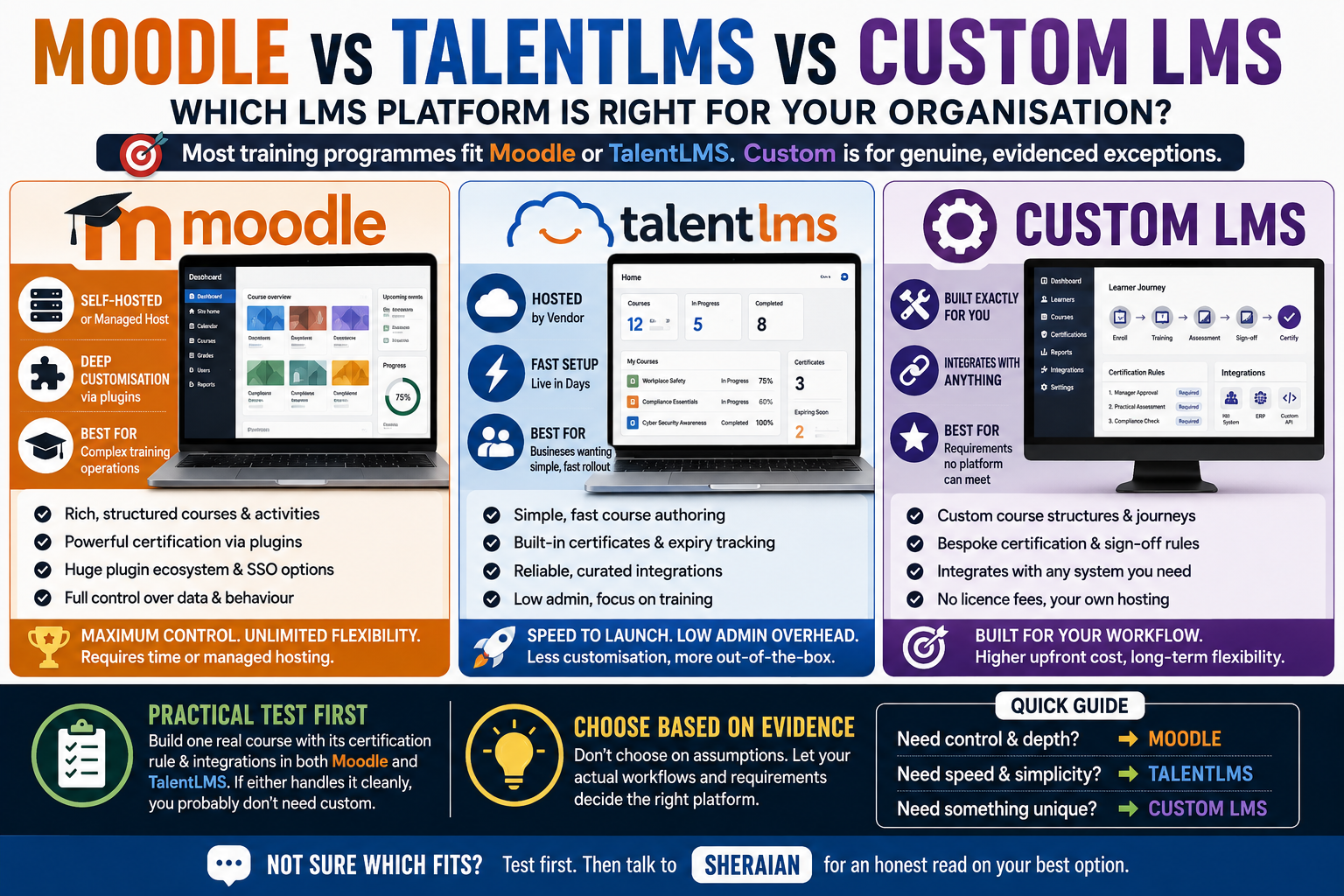
Custom LMS vs Moodle vs TalentLMS
Moodle suits organisations that need deep customisation and are willing to self-host or manage plugins. TalentLMS suits businesses that want a fast, hosted setup with minimal configuration. Custom LMS suits organisations whose course structure, certification rules, or integrations do not fit either platform's assumptions. Most training programmes fit one of the first two; custom is for genuine, evidenced exceptions.
What each option actually is
Moodle is open-source, self-hostable or available through managed Moodle hosts, with a large plugin ecosystem and deep configurability aimed at educational institutions and larger training operations. TalentLMS is a hosted, commercial platform built for fast setup, aimed at businesses that want training running within days without managing infrastructure. Custom LMS is a system built specifically around your course structure, learner journeys, and integrations, with no plugin ecosystem or vendor roadmap to work within.
The gap between the two established platforms is really a trade between control and speed. Moodle assumes you, or a managed host you pay, will invest time in configuration and plugin selection in exchange for near-complete control over structure and behaviour. TalentLMS assumes you would rather accept its opinionated defaults in exchange for being live within days. Neither assumption is wrong; the right one depends on how much internal capacity your team actually has for ongoing LMS administration.
Course authoring
Moodle supports rich, structured courses with a wide range of activity types, quizzes, forums, assignments, and SCORM packages, and rewards the time invested in learning its authoring tools. TalentLMS keeps authoring simpler and faster to learn, trading some structural depth for speed of course creation. A custom LMS can match either depth, but every authoring capability has to be built rather than inherited from the platform.
Certification and compliance tracking
Moodle handles certification well through plugins, supporting expiry dates, renewal reminders, and detailed completion records, which suits regulated training environments. TalentLMS offers built-in certificate generation and expiry tracking aimed at commercial training use cases, generally with less configurability than Moodle's plugin-based approach. Custom LMS is worth it here specifically when your certification rules, multi-step sign-off chains or regulator-specific record formats do not match either platform's model.
Integrations
Moodle's plugin ecosystem covers many common integrations, HR systems, video conferencing, single sign-on, though quality and maintenance vary significantly by plugin. TalentLMS offers a smaller, curated set of integrations maintained directly by the vendor, generally more reliable but less extensive. A custom LMS integrates with exactly what you specify, at the cost of building and maintaining every connector yourself.
Before assuming either platform lacks an integration you need, check the current plugin or app marketplace directly rather than relying on general reputation, since both ecosystems change frequently and a gap from a year ago may already be filled.
Cost and hosting
Moodle itself is free, but self-hosting requires server management, security patching, and plugin maintenance, or paying a managed Moodle host for that work. TalentLMS is a per-user subscription with hosting included, trading ongoing licence cost for zero infrastructure management. Custom LMS has an upfront build cost and no per-user licence fee, with hosting and maintenance costs similar to any custom web application.
Three-way comparison
MoodleTalentLMSCustom LMS Setup speedSlower, more configurationFast, days not weeksSlowest, full build required Customisation depthHigh, via pluginsModerate, within vendor's modelUnlimited, but all self-built HostingSelf-hosted or managed hostHosted by vendorYour own hosting Ongoing cost modelFree core plus hosting or managed feePer-user subscriptionNo licence fee, maintenance cost Best fitLarger, complex training operationsBusinesses wanting fast, simple setupRequirements no platform can meet Where each genuinely wins
Moodle wins when you need deep structural control and have the internal capacity, or budget for a managed host, to run it properly. TalentLMS wins when speed to launch and low administrative overhead matter more than deep customisation, which covers a large share of commercial training needs. Custom LMS wins only when a specific, evidenced requirement, an unusual certification workflow, a required integration neither platform supports, or a learner journey genuinely different from standard course-and-quiz structures, cannot be met by either established platform. Sheraian builds custom LMS platforms for that last category, and will say so directly when Moodle or TalentLMS is the better starting point instead.
A practical way to test this before committing budget: build one representative course, including its certification rule and any required integration, inside a Moodle trial and a TalentLMS trial. If either handles it cleanly, that is strong evidence you do not need a custom build. If both genuinely fail on the same specific requirement, that failure is the evidence a custom LMS conversation should start from, rather than a general sense that "off-the-shelf platforms feel limiting."
Frequently asked questions
Is Moodle harder to use than TalentLMS?
For administrators, generally yes, Moodle has a steeper learning curve in exchange for more configurability. For learners taking courses, both can offer a comparably straightforward experience once set up.
Can TalentLMS handle regulated compliance training?
Yes, for many standard compliance scenarios with its built-in certification and expiry tracking. Highly specific regulator record-keeping requirements are where Moodle's plugin depth or a custom build become more likely necessary.
Is Moodle really free, or are there hidden costs?
The core software is free and open-source. Hosting, plugin maintenance, and any managed-host fees are real ongoing costs that need budgeting even though there is no licence fee for the software itself.
How do I know if my certification requirements need custom software?
Test your exact certification workflow, including any multi-step sign-off or regulator-specific record format, against both Moodle's plugin options and TalentLMS's built-in features before assuming neither can do it.
Can I migrate from TalentLMS to Moodle or a custom LMS later?
Yes, though migrating course content, learner records, and completion history between systems is real work that should be planned for, not assumed to be automatic.
Does a custom LMS mean better long-term cost than a subscription platform?
Only at sufficient scale or timeframe, since custom has a larger upfront cost with no ongoing per-user fee, while TalentLMS's subscription cost scales with user count. Model both over your actual expected timeframe before deciding on cost alone.
Which is the safest default choice if I am not sure yet?
TalentLMS, for most commercial training needs, because it gets a working system running fastest with the lowest commitment, and can be reassessed once real usage reveals genuine gaps.
Not sure which of the three fits your training programme? Test your actual certification rules and integration needs against Moodle and TalentLMS before assuming custom is required. Talk to Sheraian for an honest read on whether your requirements genuinely need a custom build.