Do You Need an App or a Mobile-Friendly Website?
Most businesses only need a responsive website, not an app. Offline access, push notifications or deep hardware use are the real app triggers.
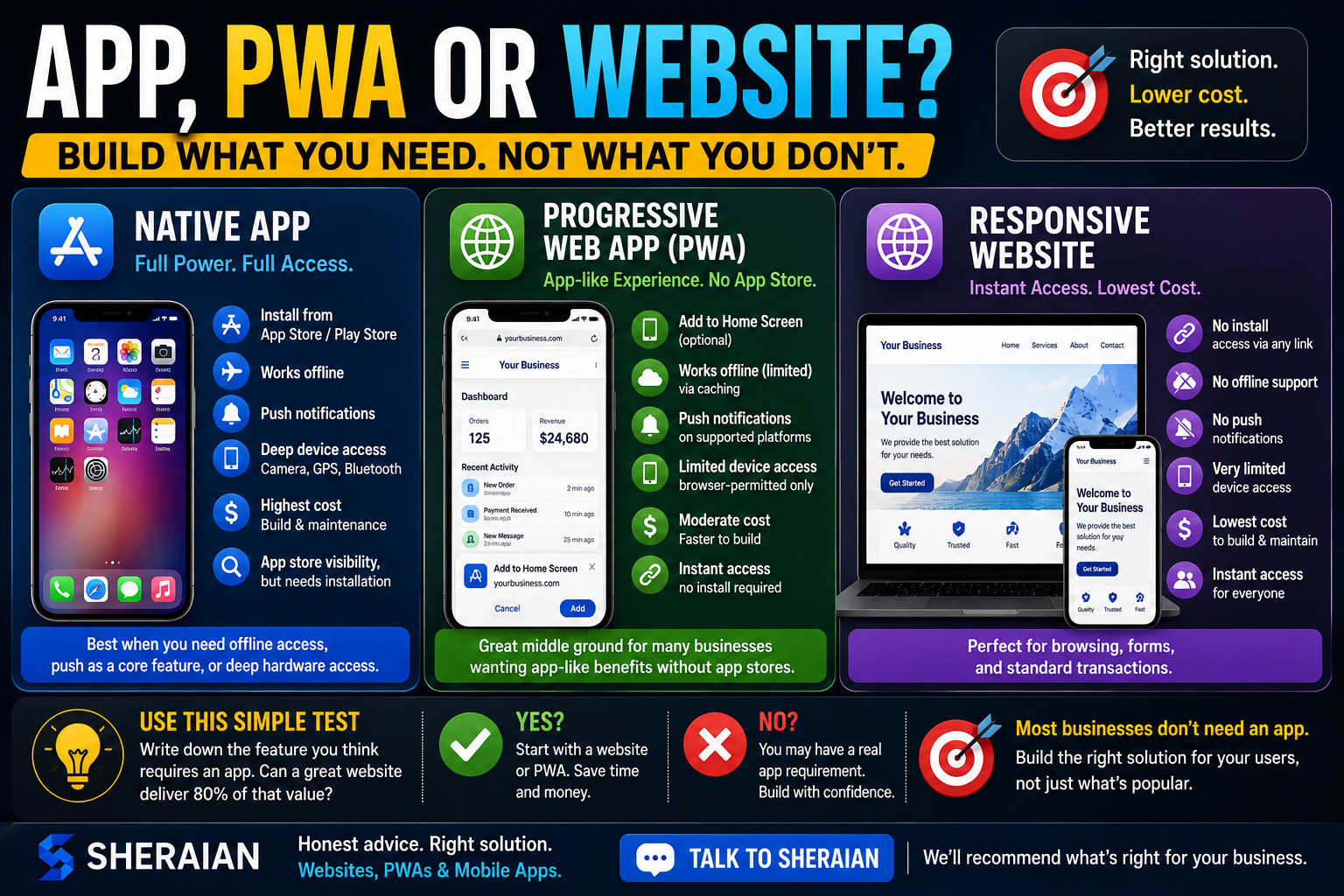
Do You Need an App or a Mobile-Friendly Website?
Most businesses do not need a native app. A responsive, mobile-friendly website covers browsing, forms, and most transactions at a fraction of the cost. An app becomes worth building when you need offline access, push notifications as a core feature, or deep use of device hardware like camera or GPS that a website genuinely cannot replicate well.
Why this question deserves an honest answer, not a default yes
An app carries ongoing cost a website does not: separate builds or a cross-platform framework, app store review and policy compliance, and updates that require users to actually install them rather than simply reloading a page. Building one because "every serious business has an app" rather than because of a specific functional need is a common and avoidable overspend.
There is also a real adoption cost that is easy to underestimate. Every app requires a user to actively decide to install it, which is a meaningfully higher barrier than simply clicking a link to a website. Many businesses that build an app discover that only a small fraction of their actual customer base ever installs it, while the website continues to serve the majority regardless.
Native app
An app installed from the App Store or Google Play, with icon access from the home screen, works fully or partially offline, and can use push notifications and deep device hardware access. It requires the highest investment of the three options, both to build and to maintain across two platforms and ongoing OS updates.
Progressive web app
A PWA is a website that can be added to a phone's home screen, works offline to a limited extent through caching, and can send push notifications on supporting platforms, without needing an app store listing or a separate codebase per platform. It sits genuinely between a website and a native app, offering some app-like capability at a website's cost and deployment speed.
Responsive website
A well-built responsive site adapts cleanly to any screen size, loads through a browser with no install step, and is immediately accessible to any visitor with a link. For businesses whose core need is browsing content, submitting forms, and completing standard transactions, a responsive site meets the need entirely without the ongoing overhead an app or even a PWA introduces.
Comparison
Native appProgressive web appResponsive website Install requiredYes, from app storeOptional, add to home screenNo Offline capabilityFullLimited, via cachingNone Push notificationsFull supportSupported on most platformsNot available Device hardware accessDeepest, full native APIsLimited, browser-permitted onlyVery limited Build and maintenance costHighestModerateLowest DiscoverabilityApp store search, but requires installInstant via any linkInstant via any link When a website genuinely is not enough
Offline access as a core requirement, not an edge case, for example a field service app used in locations without reliable connectivity, is a genuine app trigger. Push notifications as a primary engagement mechanism, rather than email, is another. Deep, continuous use of device hardware, camera scanning integrated into a core workflow, precise background location tracking, or Bluetooth device pairing, is a third. If none of these describe your actual use case, a responsive website or a PWA almost certainly covers the requirement at meaningfully lower cost.
A useful way to test this honestly: write down the specific feature that supposedly requires an app, then ask whether a well-built website could deliver at least eighty percent of that value. If the answer is yes, the remaining twenty percent rarely justifies an app's full cost on its own, and is often better addressed with a PWA as a middle step before committing to a native build.
The honest default recommendation
Most readers evaluating this question do not need an app, and saying so plainly matters more than it might seem for a company that also builds apps. Sheraian builds responsive websites as well as native and cross-platform apps, and will recommend a website first when the underlying need does not genuinely require an app's extra capability and cost.
If usage on a well-built website later reveals genuine demand for app-specific capability, that is real evidence to build from, and a far stronger basis for the investment than an assumption made before any user has interacted with the product at all.
Frequently asked questions
Will an app make my business look more established than a website?
Not inherently, and building one for perception alone rarely justifies its ongoing cost. A well-built website is a credible, professional presence for the overwhelming majority of businesses.
Can a progressive web app really replace push notifications from a native app?
On most Android devices and modern browsers, yes, PWA push notifications work well. iOS support has historically lagged, so this is worth confirming for your specific target platform mix before relying on it.
Does a responsive website rank differently in search than a native app?
Websites are directly indexed and searchable by Google; native apps are not searchable the same way unless separately optimised for app store search, which is a different discipline entirely from web SEO.
How do I know if offline access is a genuine requirement or a nice-to-have?
Ask whether your actual users will regularly be in locations without reliable connectivity while needing to use the core feature. If connectivity is reliably available in practice, offline support is solving a rare edge case, not a core need.
Can I start with a website and add a native app later if needed?
Yes, and it is a lower-risk path than building an app first on assumption. Real usage on a website often clarifies whether the specific app-only capabilities are genuinely needed before committing to the higher build cost.
Is a PWA a good middle ground for most businesses considering an app?
For many, yes, particularly if the main appeal of an app is home screen presence and some offline capability, without needing deep hardware access or full native performance.
What is the biggest mistake businesses make in this decision?
Building a native app based on a general belief that apps are more serious or professional, without a specific functional requirement a website could not meet, then carrying the ongoing maintenance cost for capability that goes largely unused.
Not sure which of the three fits your actual use case? If your core need is browsing, forms, and standard transactions, a responsive website is the honest recommendation. Talk to Sheraian about your specific requirements before committing to an app.