Flutter vs React Native: Which Should You Choose?
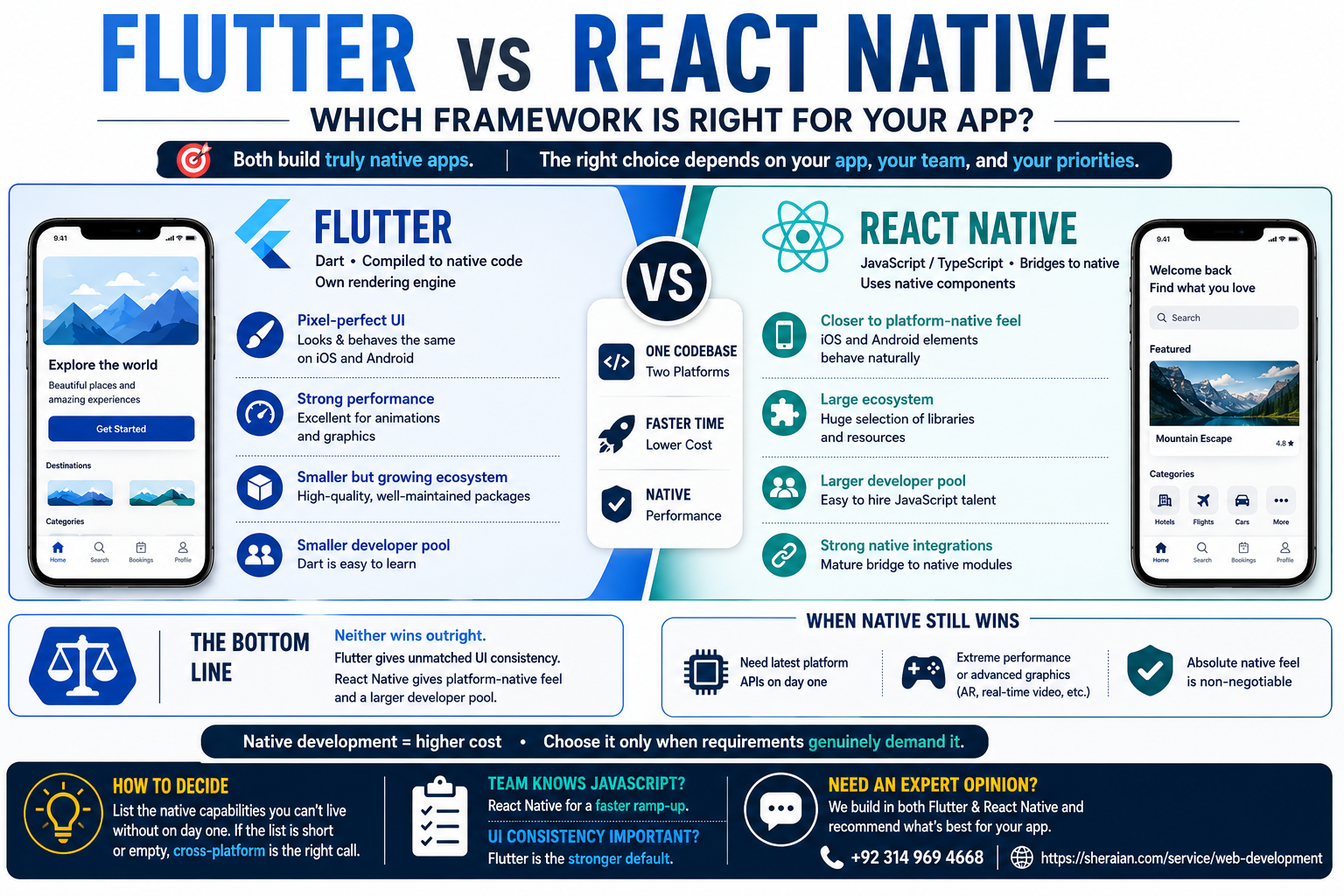
Flutter renders its own pixel-consistent UI from Dart; React Native bridges to native components from JavaScript. Native still wins for edge cases.
Flutter vs React Native: Which Should You Choose?
Flutter compiles to native code from a single Dart codebase with its own rendering engine, giving highly consistent UI across platforms. React Native uses JavaScript and bridges to native components, giving a closer feel to platform-native controls and a larger existing developer pool. Neither wins outright, and for some apps, fully native development still beats both.
Language and compilation
Flutter apps are written in Dart and compiled ahead-of-time to native ARM or x86 code, which removes a JavaScript bridge from the runtime path entirely. React Native apps are written in JavaScript or TypeScript, and historically relied on a bridge to communicate with native modules, though the newer architecture reduces that overhead significantly. In practice, both compile to genuinely native apps; the difference is in how the UI layer gets drawn.
Dart is a less widely known language than JavaScript, which is the main practical trade-off behind this technical choice. A team with strong JavaScript experience can be productive in React Native almost immediately, while the same team would need time to become equally comfortable in Dart, even though Dart itself is generally considered straightforward to pick up.
UI approach
Flutter draws every pixel itself using its own rendering engine, which means an app looks and behaves identically on iOS and Android by default, down to animations and transitions. React Native renders using actual native UI components, so controls automatically pick up small platform-specific behaviours and feel, at the cost of occasional subtle inconsistency between the two platforms that needs manual attention to fully iron out.
Performance
Both frameworks deliver genuinely native performance for the large majority of apps: standard business apps, e-commerce, content, and booking apps run smoothly on either. Performance differences that matter tend to show up in animation-heavy or graphically complex apps, where Flutter's own rendering engine gives more predictable, consistent performance, and in apps that lean heavily on complex native modules, where React Native's more mature bridge to specific native libraries can be an advantage.
Ecosystem and packages
React Native, being older and built on the much larger JavaScript ecosystem, generally has more third-party packages available, and a larger pool of existing code and examples to draw on. Flutter's package ecosystem is smaller but has grown quickly and covers the vast majority of common app requirements, with fewer abandoned or poorly maintained packages proportionally, since Google's continued investment keeps core packages well supported.
Hiring and team
Finding React Native developers is generally easier because JavaScript is a far more widely known language, and many web developers can transition to React Native with a smaller learning curve. Flutter developers are a smaller pool, though Dart is straightforward to learn for anyone with existing programming experience, and Google's continued backing has grown the talent pool steadily.
Comparison table
FlutterReact Native LanguageDartJavaScript or TypeScript UI renderingOwn engine, pixel-consistent across platformsNative components, closer platform feel PerformanceStrong, especially animation-heavy appsStrong for most apps, mature native bridges Ecosystem sizeSmaller, growing quicklyLarger, built on JavaScript's ecosystem Developer poolSmaller, growingLarger, easier to hire for Best fitConsistent UI across platforms is a priorityTeam already knows JavaScript, or heavy native module reuse needed When native beats both
Apps that need deep, continuous access to the newest platform-specific APIs the day they release, apps with extremely demanding graphics or processing requirements such as advanced AR or real-time video processing, or apps where the absolute native feel of every interaction is non-negotiable, are cases where fully native development, Swift or Kotlin written separately for each platform, still outperforms either cross-platform framework. That path costs more, since it means building and maintaining two separate codebases, and is worth it only when the specific requirement genuinely demands it.
A useful test: list the specific native capabilities your app genuinely cannot do without on day one. If that list is short or empty, cross-platform is almost certainly the right call. If it includes something like frame-accurate camera control or a specific hardware SDK with no cross-platform plugin, that is the signal native development is worth its higher cost.
How to actually decide
For most business apps, e-commerce, booking, content, internal tools, either Flutter or React Native delivers a genuinely native-feeling result at meaningfully lower cost than building twice natively. The deciding factor is usually practical rather than technical: if your team already has strong JavaScript skills, React Native has a shorter ramp-up. If pixel-perfect UI consistency across platforms matters more than platform-native feel, Flutter is the stronger default. Sheraian builds in both Flutter and React Native and will recommend based on your specific app requirements and team context, not a fixed house preference.
If you are commissioning the build rather than staffing it yourself, this decision matters less than it might seem, since the development partner's team skill sits with them rather than with you. The more useful question to ask a prospective partner is which framework they would choose for your specific app and why, since a confident, specific answer tells you more about their judgement than either framework's general reputation does.
Frequently asked questions
Is Flutter or React Native faster to develop with?
Both offer hot reload and similarly fast iteration cycles. Development speed in practice depends more on team familiarity with Dart versus JavaScript than on an inherent difference between the frameworks.
Which is better for a startup's first app?
Either is reasonable. If the founding team or early hires already know JavaScript, React Native reduces ramp-up time. If UI consistency across platforms is a priority from day one, Flutter is a stronger default.
Do Flutter apps really look identical on iOS and Android?
By default, yes, since Flutter renders its own UI rather than using native components. Developers can and often should add platform-specific adjustments deliberately where a native feel genuinely matters more than consistency.
Is React Native being replaced by Flutter industry-wide?
No. Both remain actively maintained and widely used, backed by Meta and Google respectively. Adoption differs by company and use case rather than one clearly displacing the other.
Can I switch from one framework to the other later?
Not easily. Both require a substantial rewrite to switch, since the codebases, language, and architecture are fundamentally different. Choosing carefully upfront matters more than for many other technology decisions.
Does either framework limit access to native device features?
No, both provide access to camera, location, notifications, and most common native APIs through official or well-maintained plugins. Access to brand-new platform features on release day can lag slightly behind fully native development.
Is cross-platform always cheaper than building native apps twice?
For the large majority of business apps, yes, since one codebase serves both platforms. The exception is apps with requirements genuinely demanding native performance or day-one access to new platform APIs, where the native route's higher cost is justified.
Not sure which framework fits your app? The right choice depends on your team's existing skills and how much UI consistency matters versus platform-native feel. Talk to Sheraian about your specific requirements before committing to either.