How Long Does It Take to Build a Mobile App?
A cross-platform mobile app typically takes 6-10 weeks to build; payment compliance, offline sync and hardware integrations each push that longer.
How Long Does It Take to Build a Mobile App?
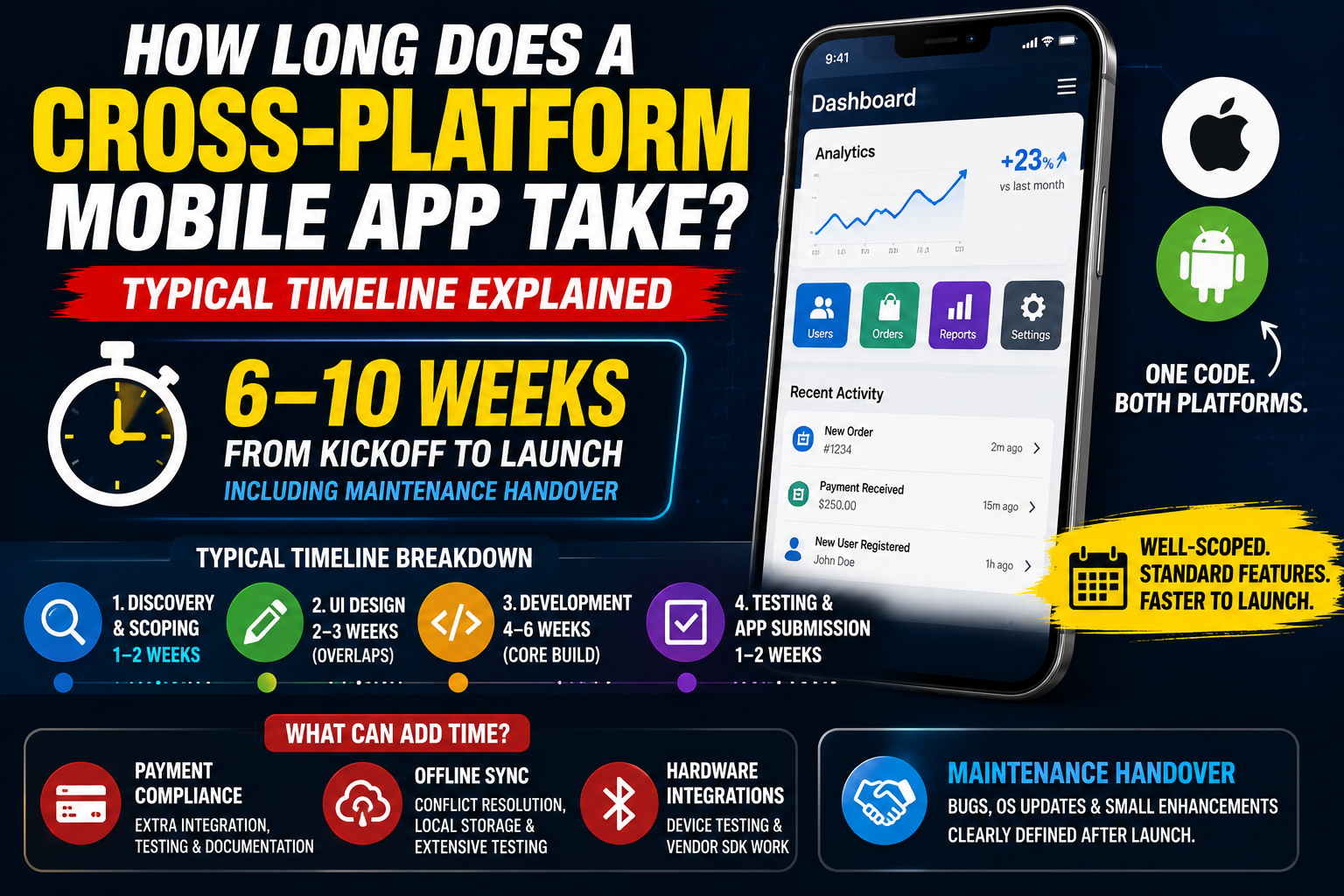
A cross-platform mobile app typically takes 6-10 weeks from kickoff to launch, including maintenance handover, for a well-scoped project with standard features. Payment compliance, offline sync, and hardware integrations each push that timeline longer. The range depends far more on scope discipline than on team size or technology choice.
What a typical timeline actually includes
A mobile app build is not one continuous block of development. It moves through discovery and scoping, UI design, development, testing, and app store submission, each with its own duration and its own risk of delay. Understanding the phases makes it possible to see exactly where a project can slip, rather than treating "how long will it take" as a single unanswerable question.
Maintenance handover, agreeing how bugs, OS updates, and small enhancements get handled after launch, is also worth including in the timeline rather than treating it as an afterthought once the app is live. A short, defined handover period at the end of the build, where the development team documents the system and agrees a support arrangement, avoids the common gap where nobody is clearly responsible for the app in its first few weeks live.
Discovery and scoping
Before development starts, requirements need to be specific enough to estimate against: screens, user flows, and any third-party integrations. This phase typically takes one to two weeks for a well-defined project, and skipping or rushing it is one of the most common causes of later delay, since ambiguous requirements get discovered and clarified mid-build instead.
Coming into discovery with existing wireframes, a competitor app you want to reference, or a written list of must-have features shortens this phase noticeably, since much of it is spent extracting exactly that information from a blank starting point when it is not already available.
UI design
Designing screens and user flows, including a round or two of feedback, typically takes two to three weeks and can often overlap partially with early development on backend or infrastructure work that does not depend on final screen designs.
Development
This is the largest phase, typically four to six weeks for a standard cross-platform app with core features: user accounts, a handful of main screens, and basic data storage. Development time scales with feature count and complexity, not simply with app size, since one complex feature can take longer than five simple ones combined.
Backend work, the server, database, and any admin panel the app depends on, usually runs in parallel with front-end screen development rather than sequentially after it. A project that treats backend and front-end as strictly sequential phases tends to run longer than one where both start close to the same time, since the two can largely be built independently once the API contract between them is agreed early.
Testing and app store submission
Quality assurance across devices and both app stores, followed by Apple and Google's review processes, typically adds one to two weeks. App store review timelines are outside a development team's control and can occasionally add unexpected delay, particularly if a submission is rejected for a policy issue and needs resubmission.
What pushes the timeline longer
Payment compliance
Integrating payment processing that must meet PCI compliance, or handling regulated financial transactions, adds meaningful time for both implementation and the additional testing and documentation regulatory compliance requires.
Offline sync
An app that must work fully offline and reliably sync data once connectivity returns needs conflict resolution logic, local data storage, and thorough testing across interrupted-connection scenarios, all of which add real development and testing time beyond an always-online app.
Hardware integrations
Connecting to Bluetooth devices, custom sensors, or specialised hardware introduces device-specific testing and often vendor SDK integration work that a standard app, using only built-in phone features like camera or location, does not need.
Typical phase breakdown
PhaseTypical duration Discovery and scoping1-2 weeks UI design2-3 weeks, can overlap with early development Development4-6 weeks for standard feature scope Testing and app store submission1-2 weeks Total for standard scope6-10 weeks How Sheraian scopes timelines
Sheraian's stated range for a cross-platform app with maintenance included is 6-10 weeks, and the honest driver of where a specific project lands in that range is feature scope agreed during discovery, not a hidden variable revealed later. Sheraian scopes mobile app timelines against your actual feature list during discovery, rather than quoting a generic industry range disconnected from your specific requirements.
A project that includes one or more of the three timeline-extending factors above, payment compliance, offline sync, or hardware integration, should expect to sit toward the higher end of that range, or beyond it, and a development partner scoping the project honestly should say so during discovery rather than quoting the standard range and revising it upward later.
Frequently asked questions
Can a mobile app really be built in under six weeks?
For a genuinely minimal feature set, yes, though most business apps with real user accounts and a handful of core screens land closer to the 6-10 week range once discovery, design, and testing are properly accounted for.
Does building for both iOS and Android double the timeline?
No, not with cross-platform frameworks like Flutter or React Native. A single codebase serves both platforms, which is precisely why cross-platform development keeps timelines closer to 6-10 weeks rather than the longer timeline two separate native builds would require.
What is the most common cause of a mobile app project running over its estimated timeline?
Scope changes introduced after development starts. A feature added mid-build affects not just its own implementation time but potentially design and testing that already assumed a different scope.
How much of the timeline is outside the development team's control?
App store review time is the main external factor, and it can vary from a day to over a week depending on the platform and whether the submission is flagged for manual review.
Does offline sync always add significant time?
It adds meaningful time in most cases, because conflict resolution and interrupted-connection testing genuinely require additional work. The exact addition depends on how complex the data being synced is.
Should discovery and design happen before signing a fixed-price development contract?
Ideally, yes. A fixed-price quote given before requirements are scoped in discovery is either padded to cover unknowns or likely to change once real requirements surface.
Can a mobile app timeline be shortened by adding more developers?
Only to a limited extent. Some work parallelises well, such as design and early backend work, but adding developers to a late-stage, tightly coupled feature build often adds coordination overhead rather than genuine speed.
Want a timeline specific to your app, not a general range? A real estimate needs your actual feature list, not a guess based on "an app like X." Talk to Sheraian to scope your specific timeline during discovery.