MRP vs ERP Which System Does Your Business Need?
MRP schedules materials and production ERP adds finance, sales and HR in one system. Compare scope, rollout time and when custom beats off-the-shelf.
MRP vs ERP Which System Does Your Business Need?
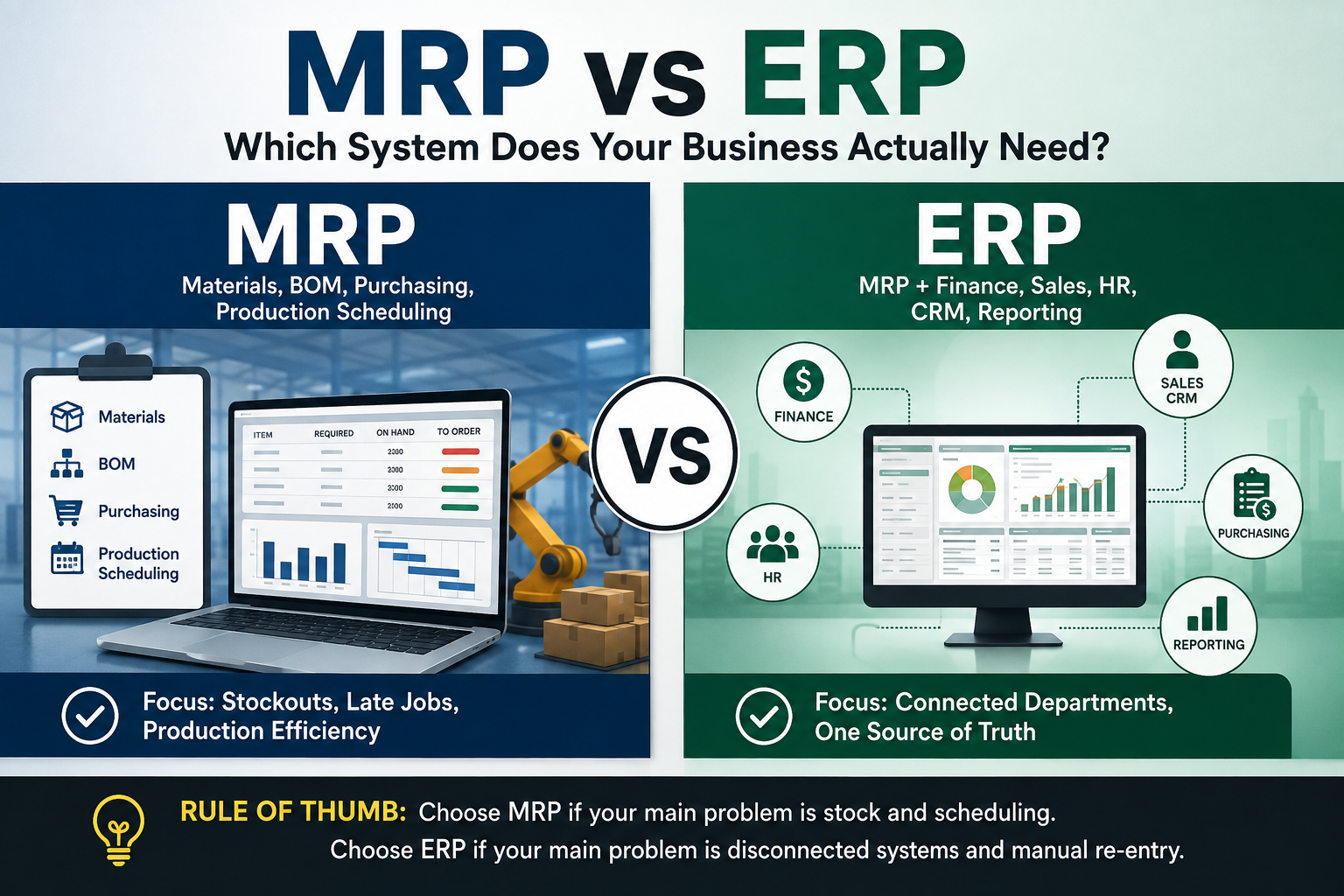
MRP (Material Requirements Planning) plans production materials: bills of materials, purchase timing, work orders and shop-floor scheduling. ERP (Enterprise Resource Planning) does that plus finance, HR, sales and company-wide reporting in one database. Choose MRP if the problem is stockouts and late jobs. Choose ERP if the problem is disconnected departments and manual re-entry between systems.
Why the two terms get confused
MRP came first, built in the 1970s to answer one question: order the right parts, in the right quantity, at the right time, so production does not stall. Vendors later wrapped that planning engine in financial ledgers, purchasing, sales, CRM and HR modules, and marketed the combined suite as ERP. That history is why almost every modern ERP product still contains an MRP module, and why some MRP-only tools get marketed under labels like "manufacturing ERP". The categories overlap because one grew out of the other, not because they mean the same thing.
What MRP covers on its own
A standalone MRP system answers production-floor questions:
- What do we need to build, and by when, based on confirmed and forecast demand?
- What raw materials and components does the bill of materials (BOM) require for that build?
- What do we already have in stock, and what is already on order?
- What still needs to be purchased or manufactured, and when must that purchase or work order be raised to hit the deadline?
MRP is narrow by design. It does not touch the general ledger, payroll, or customer invoicing. That narrowness is an advantage for a business whose actual pain is materials and scheduling: a smaller system is faster to configure, cheaper to run, and easier for a production planner to learn without a change-management programme.
Most MRP systems also produce a small set of recurring outputs that a planner checks daily: a materials requirement report showing shortfalls against the current production schedule, a suggested purchase order list with due dates, and a work order schedule sequenced against machine or line capacity. None of that requires visibility into invoicing or payroll, which is exactly why a manufacturer can run MRP well while its accounting stays on a separate, unrelated tool.
What ERP adds on top
ERP keeps the MRP planning engine and connects it to the rest of the business in one shared database: finance and the general ledger, accounts payable and receivable, sales orders and CRM, HR and payroll, and reporting that spans all of it. The benefit is a single source of truth. When a sales order is entered, finance, purchasing and the shop floor see the same record instead of three versions synced by hand or not synced at all.
| Question | MRP | ERP |
|---|---|---|
| Core scope | Materials, BOM, purchasing, production scheduling | MRP scope plus finance, sales, HR, CRM, reporting |
| Typical rollout | Weeks to a few months | Several months, often longer with multiple departments |
| Best fit | Manufacturers whose main problem is stock and scheduling | Organisations needing one system across finance, ops and sales |
| Ongoing cost driver | Fewer modules, fewer licensed users | More modules and integrations to license and maintain |
| Change management | Mostly production and purchasing staff | Spans finance, sales, HR and operations at once |
Diagnostic signs you need MRP, not ERP
- Stockouts or late jobs are the recurring complaint, not disconnected departments.
- Finance and sales already run on adequate separate tools that do not need replacing.
- The team wants a system a production planner can learn in days, not weeks.
- Budget and appetite for a multi-department rollout do not exist yet.
Diagnostic signs you need ERP, not MRP
- Finance, sales and production each keep their own numbers, and month-end involves reconciling them by hand.
- Data gets re-entered two or three times as an order moves from sales to production to invoicing.
- Leadership cannot get one accurate, current view of the business without waiting on multiple exports.
- The business is scaling and the current patchwork of spreadsheets and point tools is starting to break.
Off-the-shelf vs custom
Established off-the-shelf MRP and ERP products cover common manufacturing workflows well and are usually the sensible starting point if your processes are close to standard. Custom becomes worth considering when the off-the-shelf option forces a compromise: a BOM structure that does not match how the product is actually built, a shop-floor data capture step nobody will follow because the workflow does not fit, or integrations with existing systems that the vendor cannot support. Sheraian's custom business systems work exists for that gap, building MRP, dashboards and reporting around the workflow the business already runs, rather than making the workflow fit the software. If a configured off-the-shelf system genuinely covers the requirement, that is usually the cheaper and faster route, and worth taking.
A useful test before committing to either path: list the three workflow steps that currently cause the most rework, whether that is a BOM revision that does not match the shop floor, a purchase order that is always late because nobody trusts the reorder point, or a report finance has to rebuild by hand every month. If an off-the-shelf product's demo can show those three steps working as described, that is a strong signal to buy rather than build. If the vendor's answer to all three is "you would need to change your process to fit our system," that is the point where a custom system starts to pay for itself.
Frequently asked questions
Is MRP part of ERP, or a separate product?
Both exist. Most ERP suites include an MRP module, but standalone MRP-only products are also sold separately for manufacturers who do not need the wider ERP scope.
Can a business run MRP without an ERP system?
Yes. A standalone MRP system can sit alongside existing accounting and sales tools, provided those tools do not need to share live data with production in real time.
Does ERP replace the need for separate accounting software?
Usually, yes. ERP typically includes a general ledger and financial reporting module intended to replace or absorb standalone accounting software rather than run alongside it.
Which is cheaper to run, MRP or ERP?
MRP is typically cheaper because it covers fewer modules and licenses fewer user types. ERP costs more to license and maintain because it spans finance, sales, HR and operations at once.
How long does an MRP or ERP rollout usually take?
A focused MRP rollout is typically the faster of the two, since it touches production and purchasing staff. An ERP rollout usually takes longer because it spans multiple departments that each need training and data migration.
What size of manufacturer actually needs ERP instead of MRP?
There is no fixed headcount threshold. The signal is organisational, not size-based: once finance, sales and production stop being able to work from one consistent set of numbers, ERP scope becomes worth evaluating regardless of company size.
Can a business start with MRP and move to ERP later?
Yes, and it is a common path. Starting with MRP solves the immediate materials and scheduling problem, and ERP can be evaluated later once (or if) cross-department data consistency becomes the bigger cost.
Is custom MRP software ever the right choice over an established product?
Only when an established product cannot be configured to match how the business actually operates, for example a non-standard BOM structure or a required integration the vendor will not support. For standard manufacturing workflows, an established off-the-shelf product is usually the better starting point.
Not sure which scope your business actually needs? The honest answer depends on where the current pain sits, materials and scheduling, or disconnected departments, and an established off-the-shelf product is often the right call even when a custom build is on the table. If it would help to talk through which one fits, get in touch with Sheraian for a straight answer, including if that answer is "you don't need us yet".