Signs You Have Outgrown Spreadsheets
Spreadsheets are the right tool for a long time. Here's how to tell when yours has quietly become the biggest risk in the business.
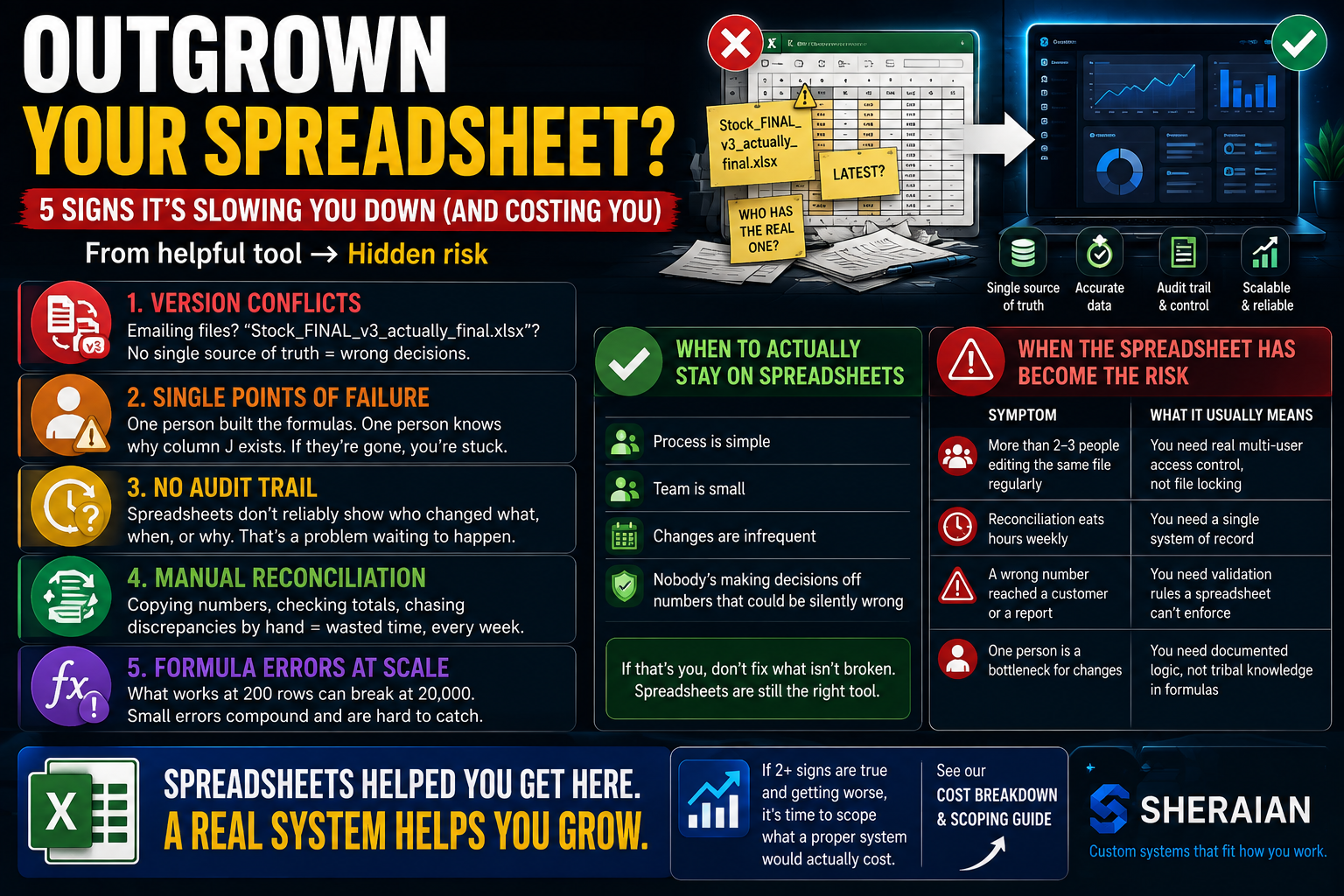
Signs You Have Outgrown Spreadsheets
Almost every custom business system starts life as a spreadsheet that worked fine for years and then quietly stopped being fine. Spreadsheets aren't a bad tool — they're often exactly the right one, for a long time, for most businesses. This isn't a pitch to replace yours today. It's a way to tell whether you actually should.
Version conflicts
If your team is emailing files back and forth, or you've got "Stock_FINAL_v3_actually_final.xlsx" sitting in a shared drive, you've already lost a single source of truth. Two people editing at once means someone's changes get silently overwritten, and nobody notices until a customer gets the wrong order.
Single points of failure
One person built the formulas. One person knows why column J exists. If that person is on holiday, or leaves, the spreadsheet keeps working right up until it doesn't — and then nobody can safely touch it.
No audit trail
Spreadsheets don't reliably tell you who changed what, when, or why. For anything touching money, stock, or customer data, that absence becomes a real problem the first time a number is wrong and you need to find out how.
Manual reconciliation
If someone spends part of every week copying numbers between systems, checking totals match, and chasing down discrepancies by hand, that's not a process — that's unpaid software development being done manually, badly, forever.
Formula errors at scale
A spreadsheet that's correct at 200 rows can be quietly wrong at 20,000. Dragged formulas that don't extend properly, a lookup that silently returns the wrong row, a sum range that stopped growing — these compound and are genuinely hard to catch by eye once volume goes up.
When to actually stay on spreadsheets
If your process is simple, your team is small, changes are infrequent, and nobody's making decisions off numbers that could be silently wrong — don't replace it. Most businesses reading a "signs you've outgrown spreadsheets" post are not actually at that point yet, and a custom system is the wrong spend for a problem you don't have.
When the spreadsheet has become the risk
SymptomWhat it usually meansMore than 2–3 people editing the same file regularlyYou need real multi-user access control, not file lockingReconciliation eats hours weeklyYou need a single system of record instead of several filesA wrong number reached a customer or a reportYou need validation rules a spreadsheet can't enforceOne person is a bottleneck for changesYou need documented logic, not tribal knowledge in formulas
If two or more of these are true and getting worse, it's worth scoping what a proper system would actually cost — see our cost breakdown — rather than continuing to patch the spreadsheet indefinitely.