Custom MRP vs Off-the-Shelf How to Decide
A three-workflow demo test with real BOM data, not vendor assumptions, is the most reliable way to decide between custom and off-the-shelf MRP.
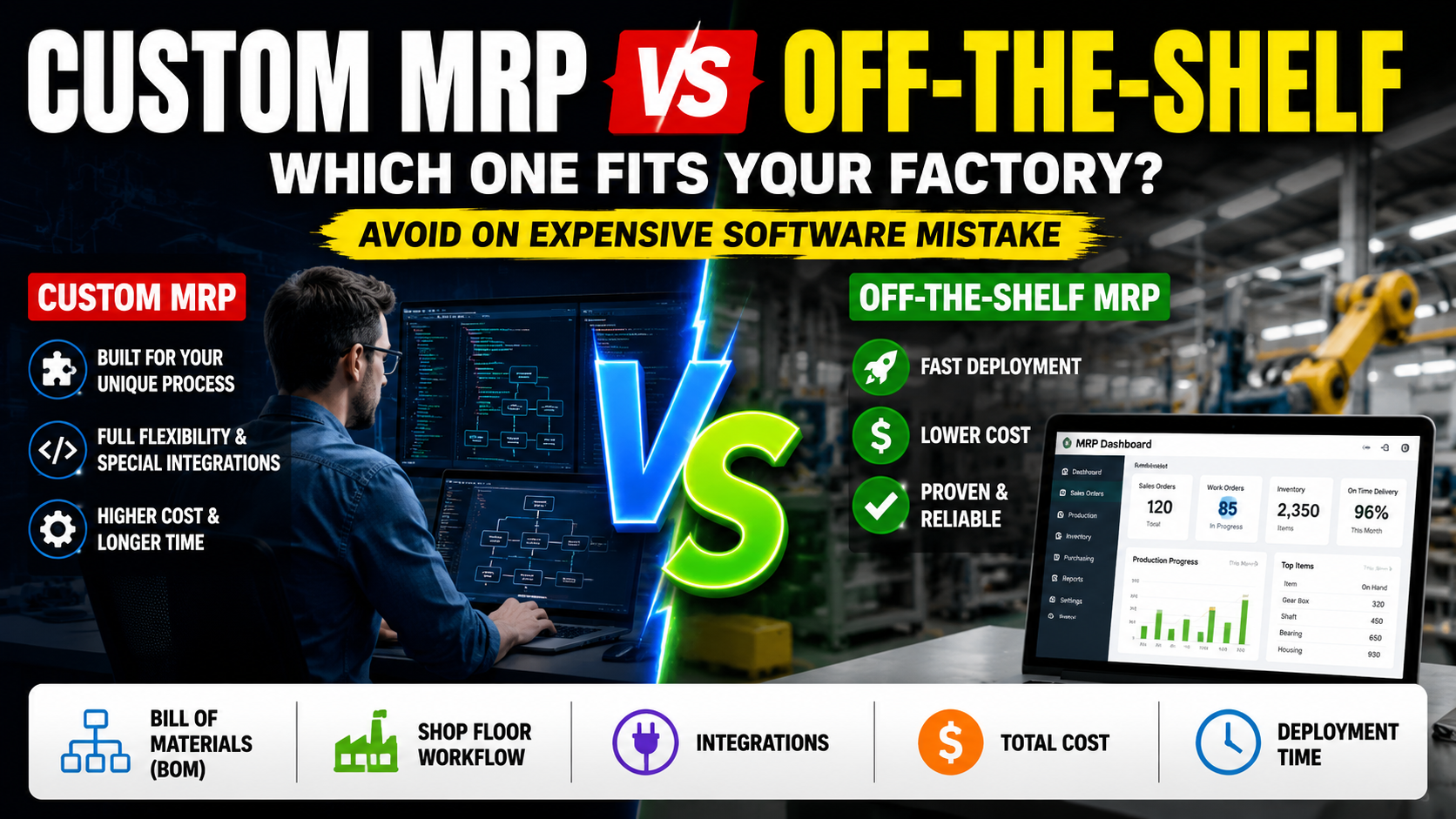
Custom MRP vs Off-the-Shelf How to Decide
Choose off-the-shelf MRP when your production process is close to standard and a configured product covers it without workarounds. Choose custom when your bill of materials, shop-floor workflow, or required integrations genuinely do not fit any established product's assumptions. Most manufacturers should start by testing an off-the-shelf product against their real workflow before assuming they need a custom build.
Why this decision gets made emotionally, not analytically
Custom software has a certain appeal: it promises a system built exactly around how you work, with nothing to compromise on. That appeal is real, but it is also how businesses end up commissioning a custom build to solve a problem an off-the-shelf product, properly configured, would have handled for a fraction of the cost and time. The decision is worth making on evidence, not on how frustrating the current spreadsheet-based process feels this week.
The reverse mistake happens just as often. A business tries one off-the-shelf product, finds it does not fit, and concludes the entire category of off-the-shelf software cannot work for them, when a different product configured differently would have. Ruling out an approach after one disappointing trial is not the same as evidence that the approach cannot work at all.
When off-the-shelf is the right call
- Your bill of materials is flat or has limited sub-assembly levels that match common product structures.
- Your shop-floor process is close to a standard make-to-stock or make-to-order workflow.
- The integrations you need, such as common accounting or e-commerce platforms, are ones the vendor already supports.
- Your team is comfortable adapting some working habits to fit the software, rather than requiring the software to match every existing habit.
When custom is worth the extra cost and time
- Your bill of materials structure genuinely does not map onto how any evaluated product models products, sub-assemblies, and variants.
- Your shop-floor capture method, for example machine-integrated data feeds, is not supported by available products.
- You depend on integrations with in-house or unusual systems that no vendor will build a connector for.
- You have already tried configuring an off-the-shelf product and hit a hard limit, not a preference.
A practical test before deciding
Take your three most complex real workflows, not simplified examples, and ask a shortlisted off-the-shelf vendor to demonstrate each one in a live demo using your actual bill of materials structure. If the vendor can show all three working as your business actually needs them, without "you'd need to change your process" as the answer, that is strong evidence off-the-shelf will work. If the vendor's answer to any of the three is that your process would need to change to fit the software, weigh how disruptive that change genuinely is against the cost of a custom build.
Scenario table
ScenarioBetter choice Standard make-to-stock manufacturing, common integrationsOff-the-shelf Multi-level BOM with unusual sub-assembly variantsCustom, if a vendor demo cannot handle it Tight budget, need to be running within weeksOff-the-shelf, configured minimally at first Integration with a bespoke in-house systemCustom, unless the vendor already supports it Team resistant to changing any existing habitsCustom, though this is worth challenging first Growing fast, requirements likely to change within a yearOff-the-shelf, for now, to avoid locking in an assumption The cost of getting this decision wrong
Choosing custom when off-the-shelf would have worked means paying for build time and ongoing maintenance for a system that solves a problem a configured product already solves. Choosing off-the-shelf when custom was genuinely needed means months of forcing your process to fit software assumptions that do not match, then eventually commissioning a custom build anyway, having lost the time and the licence spend. Neither mistake is cheap, which is why the practical test above, using your real workflows rather than assumptions, matters more than either instinct.
There is also a middle path worth naming: some off-the-shelf products support enough configuration or a plugin ecosystem that what feels like a hard limitation is actually a settings change or a small paid add-on. Before ruling out a product entirely, it is worth asking the vendor directly whether the specific limitation you have hit is configurable, rather than assuming the product's default behaviour is fixed.
What a genuinely balanced answer looks like
Most manufacturers evaluating this decision should expect to land on off-the-shelf, at least for an initial system, because most manufacturing processes are closer to standard than they feel from the inside. Sheraian will tell you honestly if your requirements are met by configuring an established product, even though a custom build is the more complex piece of work to sell. See MRP vs ERP: Which System Does Your Business Need to first confirm you are even scoping the right category of system before comparing custom against off-the-shelf within it.
If you are still undecided after the practical test, that itself is useful information: a genuinely close call usually means off-the-shelf is safe to start with, since a real, disqualifying mismatch tends to be obvious rather than marginal once tested against your actual workflows.
Frequently asked questions
Is custom MRP software always better than off-the-shelf?
No. For most manufacturers with standard workflows, a well-configured off-the-shelf product is the better choice on cost, time to deploy, and ongoing maintenance.
How do I know if my BOM structure is "standard" or not?
Ask a shortlisted vendor to model your actual bill of materials, including sub-assemblies and variants, in a live demo. If they can do it without workarounds, your structure is standard enough for that product.
What is the biggest risk of choosing off-the-shelf when I actually needed custom?
Months spent forcing your process to fit the software's assumptions, followed by commissioning a custom build anyway once the limitation becomes unavoidable, having lost the licence spend and the time.
What is the biggest risk of choosing custom when off-the-shelf would have worked?
Paying build and maintenance cost for a system that a configured off-the-shelf product would have delivered for less, with no ongoing licence savings to offset the higher upfront cost.
Can I switch from off-the-shelf to custom later if I outgrow it?
Yes. Starting with off-the-shelf and moving to custom once specific, evidenced limitations appear is a lower-risk path than committing to custom before you know exactly what off-the-shelf cannot do.
Should I let my team's resistance to changing habits decide this?
Only after testing whether the resistance is about a genuine workflow mismatch or about preferring familiar habits. The second is worth challenging before it drives a costly custom build.
How long should the evaluation process take?
A focused evaluation, including live demos of your three most complex real workflows against two or three shortlisted products, can usually be completed within a few weeks.
Not sure which side of this decision you fall on? Run the three-workflow test above against a shortlisted off-the-shelf product before assuming custom is required. If the honest answer after that test is off-the-shelf, that is the right outcome, not a consolation prize. Talk to Sheraian if you want a second opinion on the test results, including if that opinion is to keep looking at off-the-shelf options.